
The Commoditization Of Alternative Payments
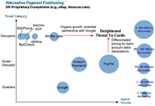
In the past three years, alternative payments have gained considerable market value with no loss of momentum in sight. Alternative payments currently account for roughly 15 percent of total e-commerce volume. However, by offering a superior value proposition to buyers, alternative payments pose a threat to traditional payment methods, according to a new report from Celent, LLC. PayPal's recent acquisition of Bill Me Later validates Celent's assessment that the strongest value is derived from the creation of sales lift.
In less than a decade, alternative payments have evolved from "dot bomb" burnouts to widely accepted, widely recognized forms of online payment, Celent notes. Alternative players' business models once relied on their solutions' status as "something new" or the only way to pay in a particular online environment. However, they now focus on providing greater value than payment cards. Card brands and issuers stand to forgo $345M in volume in 2010 and about $1.7 B in volume in 2015 to alternative payment.
Given cards' historical dominance over online payments, this market is the card industry's to lose, Celent says. Every time a bank account is debited via ACH rather than a card, the card industry loses roughly 1.5 - 2.4 percent or more of the transaction size. The card industry must pay attention to alternative payments, which can be categorized as enablers, quasi-disruptors, or disruptors, in order to prevent further losses.
Enablers offer a technological "wrap around" for payment cards that lead to increased card volume when cards are used as the source of funds, Celent found. Quasi-disruptors are players that allow for both cards and other funds sources (e.g., bank accounts) to be used. Should bank accounts be used instead, these same players take on disruptive qualities. Finally, disruptors are solutions in which the card industry plays no role whatsoever.
However, the outlook is not entirely rosy for alternative payments. "Alternative payments players have already become commodities in terms of security, convenience and pricing. The real differentiator is their ability to induce purchases and affect a corresponding sales lift. Of all the major alternative payments players, Bill Me Later understands this the best," says red Gillen, senior analyst with Celent's banking group and author of the report. "The greatest threat to the card industry is a disruptive alternative payments solution that has figured out how to increase online merchants' sales. With its recent acquisition of Bill Me Later, PayPal is obviously a believer in this fact."
"The spoils will go to those players who understand that their role is no longer simply making shoppers able to pay. Instead, such players realize that, going forward, they must make shoppers want to pay," he adds.
SOURCE: Celent, LLC